The essence
Ashrams, temples and monasteries can create conditions that support spiritual growth. Shared practice, teachers, routines and a community with similar aims can make a real difference. Yet living in such a place does not automatically confer spiritual realization, and belonging to a community still requires discernment and healthy boundaries.
A Place for Spiritual Practice
Ashrams, temples and monasteries differ across traditions and places. We should be careful about treating all of them as though they worked in the same way.
The idea that someone moves into such a place simply to withdraw from the world can be misleading. Certainly, the environment changes. But people in many fields choose to surround themselves with those who share a particular direction.
Entrepreneurs often seek the company of other entrepreneurs. A vegetarian who wants to avoid meat being mixed into their food may prefer to share a kitchen with other vegetarians. There is nothing particularly strange about wanting an environment that supports the way we intend to live.
For someone pursuing spiritual life, living alongside others with similar commitments can serve a still deeper purpose.
A Daily Life That Supports the Goal
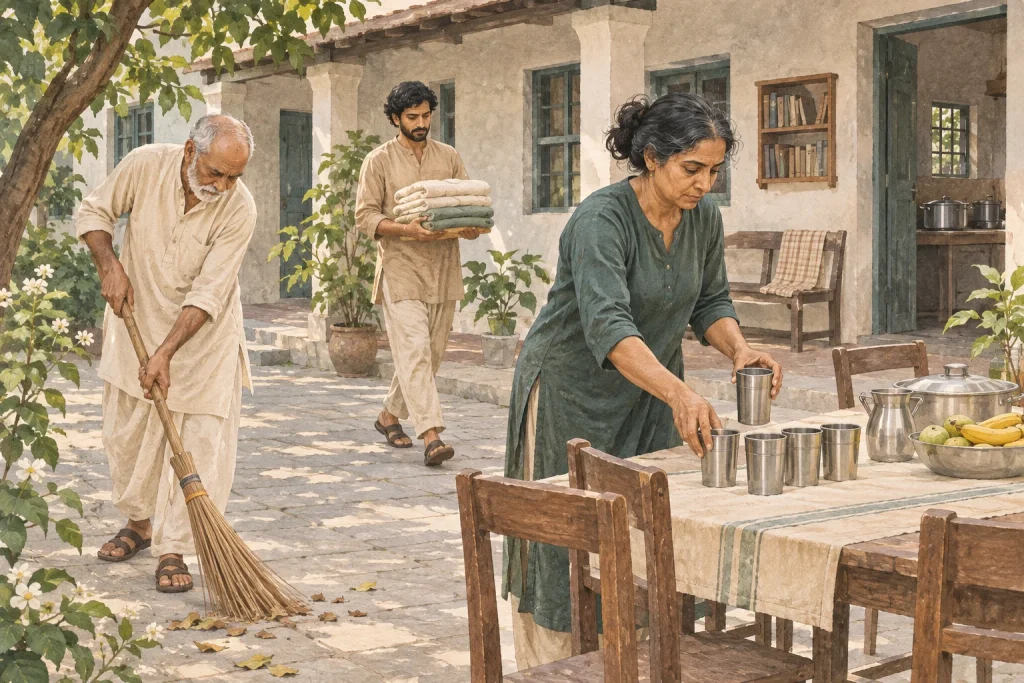
An ashram is more than a collection of like-minded people. Its way of life is deliberately organized around spiritual practice. The schedule, shared responsibilities, teachings and guidance all shape what people give their attention to.
Depending on the tradition and the particular community, that may involve early worship, meditation, chanting, studying sacred texts, service, shared meals and a disciplined daily routine. The details and expectations vary considerably.
Living this way can make practices that are difficult to maintain alone more regular and natural. It can also expose us to examples of dedication and service that we might rarely encounter in an ordinary setting.
The people we spend time with and the practices we repeat influence our habits, priorities and desires. This is part of the positive potential of spiritual association.
Why We Should Not Expect Everyone to Be a Saint
But an ashram does not automatically make everyone who lives there a saint. People come with different histories, weaknesses, levels of commitment and degrees of realization.
The false ego can remain strong even in a setting dedicated to overcoming it.
Someone may be drawn to spiritual life because they recognize precisely how much work remains to be done. Joining a community can be part of that work, not proof that the work is finished.
Whether we visit a temple for a day or consider living in an ashram for a while, it helps to arrive with realistic expectations. We can appreciate the purpose of the place without demanding perfection from everyone we meet.
Good Association, Difficult Association
There are two sides to communal spiritual life. Good association can encourage sincerity, discipline, tolerance and spiritual understanding. But shared living can also bring social pressure, rigid expectations, conflict and influences that are not necessarily helpful.
One of the difficult lessons may be learning to remain true to our own considered understanding while still being willing to learn from others. We have to develop tolerance, accept the ordinary imperfections of people around us and gradually find our own way.
At the same time, we need to recognize our limits. Being open to correction is valuable, but that does not mean we should accept every demand, surrender our judgment or allow harmful behaviour to continue.
A rule that helps someone develop discipline and an arbitrary pressure to conform are not necessarily the same thing. Learning to distinguish between them can be difficult, especially when belonging to a community matters deeply to us.
A supportive environment should help spiritual growth without making personal discernment impossible. Living together can support sincere practice; whether that practice is changing a person’s character is a related but different question.
What Makes Such a Place Worth Visiting?
The value of an ashram does not depend on the claim that everybody living there has already reached the spiritual goal. It lies in the opportunity to engage in a serious way of life, to practise alongside others and to learn from people who may be further along the path.
The community itself should also be open to honest questions about its practices, conduct and the responsibilities of its leaders. A meaningful spiritual environment need not be beyond criticism.
An occasional temple visit and a longer stay are different experiences. Both may be worthwhile, but each requires its own expectations and preparation.
Before arranging a visit or a longer stay, ask the particular community about its schedule, expectations and whether it offers residential stays. Those practical details vary from place to place.


Leave a Reply