Meditation is not only about becoming still. It is the practice of noticing where the mind goes, learning to guide it, and choosing what deserves our attention. Some practices begin with silence. Others with sacred sound. Both can teach us something important: the mind is active, and what we repeatedly return to shapes us.
Start with sound. Or start with stillness.
Two Ways To Begin
You do not need to decide what kind of meditator you are before you begin. Try a method. Notice what it does to your attention. Then go deeper.
01 MANTRA MEDITATION · Meditation through sacred sound
Give the mind something meaningful to return to. Instead of demanding mental emptiness, mantra gives attention a living object: sound. On this page, the Hare Kṛṣṇa Mahā-mantra is the central practice.
02 SILENT AWARENESS · Meet the mind as it is
Become quiet enough to notice your body, thoughts, impulses and present state. The aim is not to force a permanent blank mind, but to become aware of what is already happening.
What is meditation?
Foundation
Meditation can take many forms, but the word should not become so broad that it means every spiritual activity. At its core, meditation involves intentionally placing attention and sustaining it, or returning it again and again, on a chosen object, reality or field of awareness.
1 · Attention
Something enters awareness.
2 · Concentration
You intentionally bring the mind to one place.
3 · Meditation
You learn to remain there, and return when the mind wanders.
4 · Absorption
Attention becomes increasingly continuous and deep.
5 · Samādhi
Deep spiritual absorption: not unconsciousness, but intensified awareness.
What we follow shapes us.
What repeatedly receives our attention can influence how we think, desire and act. In meditation, we deliberately return attention to an object or practice we have reason to value.
The question is not only whether we can concentrate. It is also: what is worthy of our concentration?
Sometimes, being still is enough to notice.
Silent Awareness
We are alive, and the mind is active. In this introductory exercise, the aim is not to force thoughts to disappear. But a few quiet minutes can reveal a great deal: tension in the body, repetitive thoughts, emotional weather, hidden urgency, or the simple fact that the mind rarely stays where we put it.
Silent meditation can therefore be useful as observation. It lets us meet our present condition before we try to change it.
- Sit in a position you can actually maintain. A chair is fine.
- Let the body settle. Notice breath, sensation and sound without trying to manufacture peace.
- When thoughts appear, notice them. Do not build a story around them.
- At the end, ask one question: Where did my mind keep going?
What if the mind had somewhere meaningful to go?
Mantra Meditation
Mantra meditation uses sacred sound as the object of attention. Instead of fighting every thought, we return to sound. The practice becomes concrete: the voice chants, the ears hear, the attention returns.
In the Gauḍīya Vaiṣṇava understanding, the Mahā-mantra is not merely a concentration device. The Holy Name is approached as spiritual sound and as a direct address to Kṛṣṇa and His spiritual energy. That changes the practice from a technique for producing a state into an act of relationship.
Hare Kṛṣṇa Hare Kṛṣṇa / Kṛṣṇa Kṛṣṇa Hare Hare / Hare Rāma Hare Rāma / Rāma Rāma Hare Hare
How to practice Japa
Japa / Practice Guide
Japa is the personal repetition of a mantra, traditionally counted on a mālā. It is simple enough to begin immediately, but deep enough to refine for a lifetime.
If you are new, begin with a small, honest commitment that you can repeat. The purpose is not to win a battle against the mind in one session. The practice is the returning itself.
- Find a place with as little friction as possible. You do not need a perfect meditation room.
- Use a mālā with 108 counting beads and one larger head bead. Hold a counting bead gently between the thumb and middle finger of the right hand, keeping the index finger away from the beads. Begin next to the head bead.
- Chant one complete Mahā-mantra on one bead. Let yourself hear the words you are producing.
- Move to the next bead and repeat. Do not rush simply to finish.
- When the mind wanders, notice it without drama. Return to the sound of the next mantra.
- At the head bead, do not cross over it. Turn the mālā and continue in the opposite direction if you are doing another round.
For a more detailed introduction, read Japa Meditation: A Step-by-Step Guide.
What can we meditate on?
Remembrance
Meditation needs direction. In devotional practice, attention can be placed not only on sound, but on Kṛṣṇa Himself, His name, form, qualities, activities, teachings and our relationship of service.
Reading can become contemplation when information turns into sustained reflection. Hearing can feed remembrance. But reading, hearing, kīrtan and service are not simply synonyms for meditation, they are distinct spiritual processes that can support and deepen one another.
NAME · The Holy Name
Hear the mantra and let attention rest in sacred sound.
FORM · The form of Kṛṣṇa
Contemplate a Deity form or sacred image with attention rather than visual consumption.
QUALITIES · Qualities
Mercy, beauty, playfulness, courage, compassion, protection.
LĪLĀ · Activities & stories
Remember a pastime or sacred story slowly enough for it to become present in the mind.
WORDS · Teachings
Read a verse, close the book, and stay with one idea instead of immediately collecting the next.
RELATIONSHIP · Prayer & service
Meditation deepens when the question changes from “What can I get?” to “How can I serve?”
Technique matters. Mood matters more.
The Inner Direction
We can repeat a mantra while the inner attitude remains transactional: give me peace, give me an experience, make me feel spiritual. Devotional practice points the attention in another direction.
That final prayer is central in Śrīla Prabhupāda’s explanation of the Hare Kṛṣṇa mantra. The mantra is not a demand that the Divine fulfill our plans. It is a request that our own direction be changed.
LONGING · A sincere desire for connection, not emotional performance.
DEPENDENCE · The humility to ask for help instead of treating consciousness as a self- engineering project.
SERVICE · A movement from “What can I receive?” toward “Please engage me in Your service.”
Don’t meditate for an experience.
A Useful Warning
Peace. Bliss. Visions. Energy. Silence. A sense of expansion. Meditation is easily romanticized, and spiritual practice can become another form of consumption: we sit down expecting an impressive state and judge the session by whether we received it.
Some sessions may feel peaceful. Others restless. Some may feel completely ordinary. The practice is not to manufacture a special state. It is to listen, return and continue.
Meditation isn’t always peaceful.
Real Practice
The mind jumps. The body hurts. You become sleepy. Five minutes suddenly feel long. You finish a mantra and realize you did not hear a word of it. None of this automatically means the practice is failing. Often it means you have begun noticing what was already happening.
MY MIND WON’T STOP · Do not try to win an argument with every thought. Hear the next mantra. Then the next.
I CAN’T CONCENTRATE · Chant audibly. Remove the phone. Work with a shorter unit of practice and make one mantra clear.
MY BODY HURTS · Change position. Sit on a chair. Stand. Walk. Pain is not proof of spiritual seriousness.
I GET SLEEPY · Open the eyes, stand up, walk, chant more clearly, or practice at a time when the body is actually awake.
IT FEELS MECHANICAL · Slow down. Listen for the first word. Then the next. Mechanical practice is improved by renewed attention, not by pretending to feel something.
I FEEL NOTHING · Do not audit every session for results. Look at the direction of practice over weeks and months.
ALONE IS DIFFICULT · Practice with others. Kīrtan can make sacred sound easier to enter because attention is carried by voice, response and rhythm.
You can meditate while walking.
For more help with common obstacles, read Why Is Meditation So Difficult?.
Move If You Need To
Japa does not require a frozen body. If sitting makes you dull, restless or uncomfortable, walk slowly while chanting. The body moves, but the object of attention remains the same.
When stillness is difficult, sing.
Kīrtan
Kīrtan is a distinct devotional process of chanting together. One person leads. Others respond. Voice, rhythm and community can make sustained attention to sacred sound easier than solitary practice, especially when the mind feels heavy or scattered.
You can begin at home. Play a call-and-response kīrtan. Listen to the lead phrase. Sing the response. You do not need an instrument or a trained voice. Participation is the practice.
- LISTEN, let the lead voice establish the mantra.
- RESPOND, sing the mantra back rather than remaining a spectator.
- STAY, notice how repetition, rhythm and community affect your attention.
Meditation can take many forms. But not everything is the same thing.
Many Forms, Clear Terms
Mantra repetition, silent observation, remembrance, contemplation and visual focus can all function as meditation when attention is intentionally sustained. But a spiritual life contains more than meditation, and it is useful not to collapse every practice into one label.
These processes can feed one another. Hearing may become remembrance. Chanting may become meditation. Meditation may deepen prayer. The point is not to force them into one category, but to understand how attention can become relationship.
ŚRAVAṆAM · Hearing
Receiving sacred sound, teaching and narration attentively.
KĪRTANAM · Chanting
Voicing the Holy Name and sacred teachings, alone or together.
SMARAṆAM · Remembering
Allowing what has been heard to remain alive in consciousness.
PRAYER · Addressing
Speaking to God rather than only observing the mind.
SERVICE · Engaging
Using body, mind, time and ability in purposeful service.
The practice is powerful. The goal matters.
Why Meditate?
People meditate for very different reasons. Some want calm. Some want mastery of attention. Some seek freedom from suffering or material identity. Some seek mystical power. Some seek the Absolute. The same word, meditation, can therefore point toward very different ambitions.
CALM & CLARITY · A quieter relationship with thought; practical steadiness.
CONCENTRATION · The ability to place and hold attention deliberately.
SELF-REALIZATION · Understanding the conscious self beyond changing body and mind.
PURIFICATION · Freedom from compulsive material desire and cultivation of spiritual qualities.
LIBERATION · Freedom from material bondage and, for some seekers, realization of impersonal Brahman or release from suffering.
GOD-REALIZATION · Knowledge of the Divine not only as an idea, but as ultimate reality.
LOVE OF GOD · A positive spiritual relationship characterized by love, remembrance and service.
A Side Path: Power & Gain
Yogic literature also describes material attainments and siddhis, unusual powers or capacities. They may fascinate the mind, but power is not the same as realization. A person can seek control and still remain centered on the self.
Who is the one experiencing all of this?
Self-Realization
The body changes. Thoughts appear and disappear. Emotions move. Roles come and go. Yet experience is continually witnessed from a first-person center. Spiritual traditions ask whether that conscious self can be reduced to the changing contents it observes.
In the Bhagavad-gītā, self-realization begins with the distinction between the temporary body and the enduring conscious self, the ātmā. Meditation can make this inquiry experiential: What changes? What observes the change? What am I when I am not simply following every thought that appears?
A clearer mind is useful. A cleaner heart goes deeper.

Purification
Spiritual practice does not merely aim to make an already-centered ego calmer. It exposes what drives us: envy, fear, pride, greed, craving, resentment, the need to control. In the language of Śrī Caitanya, chanting cleanses the mirror of the heart, ceto-darpaṇa-mārjanam.
Purification is not emotional sterilization. Desire is not erased into blankness; its direction changes. As material compulsion weakens, qualities such as humility, patience, compassion, truthfulness, gratitude, steadiness, detachment and a desire to serve can be cultivated more deeply.
HUMILITY / PATIENCE / COMPASSION / TRUTHFULNESS / GRATITUDE / STEADINESS / DETACHMENT / SERVICE
Freedom is profound. But what is freedom for?
Freedom And The Positive Goal
Many spiritual paths emphasize freedom from suffering, attachment, rebirth or material identification. Some seek realization of Brahman, the impersonal Absolute. These are serious aims, not small benefits.
Bhakti asks an additional question: if consciousness is freed from what binds it, what is its positive relationship with the Divine? From this perspective, liberation is not the end of meaning. The highest direction is God-realization and love of God, knowing, remembering and serving the Supreme in relationship.
Not unconsciousness. Absorption.
Samādhi / Trance
“Trance” can sound like hypnosis, numbness or losing awareness. Samādhi is better understood as deep absorption. The scattering of attention decreases. The object of meditation becomes increasingly continuous in consciousness.
In devotional meditation, the ideal is not an empty consciousness but consciousness absorbed in the Divine. The depth of meditation is therefore not measured only by how little you notice the room around you, but by what the consciousness has become absorbed in.
CONCENTRATION · attention is deliberately placed
MEDITATION · attention is sustained and repeatedly restored
ABSORPTION · the flow becomes increasingly uninterrupted
SAMĀDHI · deep spiritual absorption
What does the Gītā call the highest yogī?
Bhagavad-Gītā 6.47
yoginām api sarveṣāṁ / mad-gatenāntar-ātmanā / śraddhāvān bhajate yo māṁ / sa me yukta-tamo mataḥ
In Bhagavad-gītā 6.47, Kṛṣṇa describes the highest yogī as one who inwardly abides in Him, thinks of Him with faith, and engages in loving service. Śrīla Prabhupāda’s purport is equally explicit: the ideal yogī concentrates attention on Kṛṣṇa, His form, names, qualities and personality, and bhakti-yoga is presented as the culmination of yoga.
This is why the page does not end with concentration itself. Attention is training. The deeper question is where that trained attention ultimately rests.
What about Oṁ, and other mantras?
Sacred Sound
Oṁ is the ancient Vedic praṇava, a sacred syllable representing the Absolute. It belongs naturally in a discussion of meditation and sacred sound. But this guide does not treat every mantra as an interchangeable audio tool.
Other names of God, including Rāma and Sītā-Rāma, may appear naturally in devotional kīrtan. For a beginner page, clarity is more useful than presenting a catalogue: one central practice, with context around it.
Oṁ · A foundational Vedic sacred syllable; useful for explaining the wider world of mantra and the Absolute.
HARE KṚṢṆA MAHĀ-MANTRA · The central practical mantra of this page: personal, relational and especially suited to Japa and kīrtan.
Oṁ namo bhagavate vāsudevāya · A classical Vaiṣṇava mantra appearing at the opening of Śrīmad-Bhāgavatam: an offering of respect to Bhagavān, Vāsudeva.
The brāhmaṇa who burned his finger in meditation
A Story Of Absorption
A traditional Vaiṣṇava story tells of a poor brāhmaṇa who lacked the resources for elaborate worship. He learned that he could serve the Lord within the mind. In meditation he imagined collecting fine ingredients, preparing sweet rice and offering it beautifully.
When he touched the imagined pot of sweet rice to check its heat, the meditation broke, and, in the story, his physical finger was burned. The account is not offered as a neuroscience experiment. Within the tradition, it illustrates the seriousness of inner service and the extraordinary depth that meditative absorption can reach.
What can science tell us?
Meditation Under The Microscope
Enough to be interesting, not enough to turn spiritual claims into laboratory conclusions. Research can measure stress, behavior, attention and brain activity. It cannot measure whether the soul has been realized, whether sacred sound is non-different from God, or whether love of God has awakened.
The most serious stance is simple: let science speak about what its methods can test, and let spiritual philosophy make its own claims transparently rather than borrowing scientific language for authority.
EEG · Lutz et al. (2004) compared eight experienced Buddhist practitioners with ten controls during compassion meditation. Differences in gamma activity do not establish training as their cause or demonstrate effects of Japa.
CLINICAL OUTCOMES · Goyal et al. (2014) reviewed 47 trials (3,515 participants). Mindfulness programs had moderate evidence for anxiety, depression and pain; other outcomes were less certain. These findings neither establish Japa’s effects nor verify bhakti’s theological claims.
Beginning a practice
Reading can clarify a method. Practice reveals what the mind actually does. Begin with a modest period of attentive chanting or quiet observation, return to it regularly, and ask for qualified guidance as questions arise.
Explore the 7-Day Meditation Experiment or the 30-Day Meditation Practice for a structured practice.
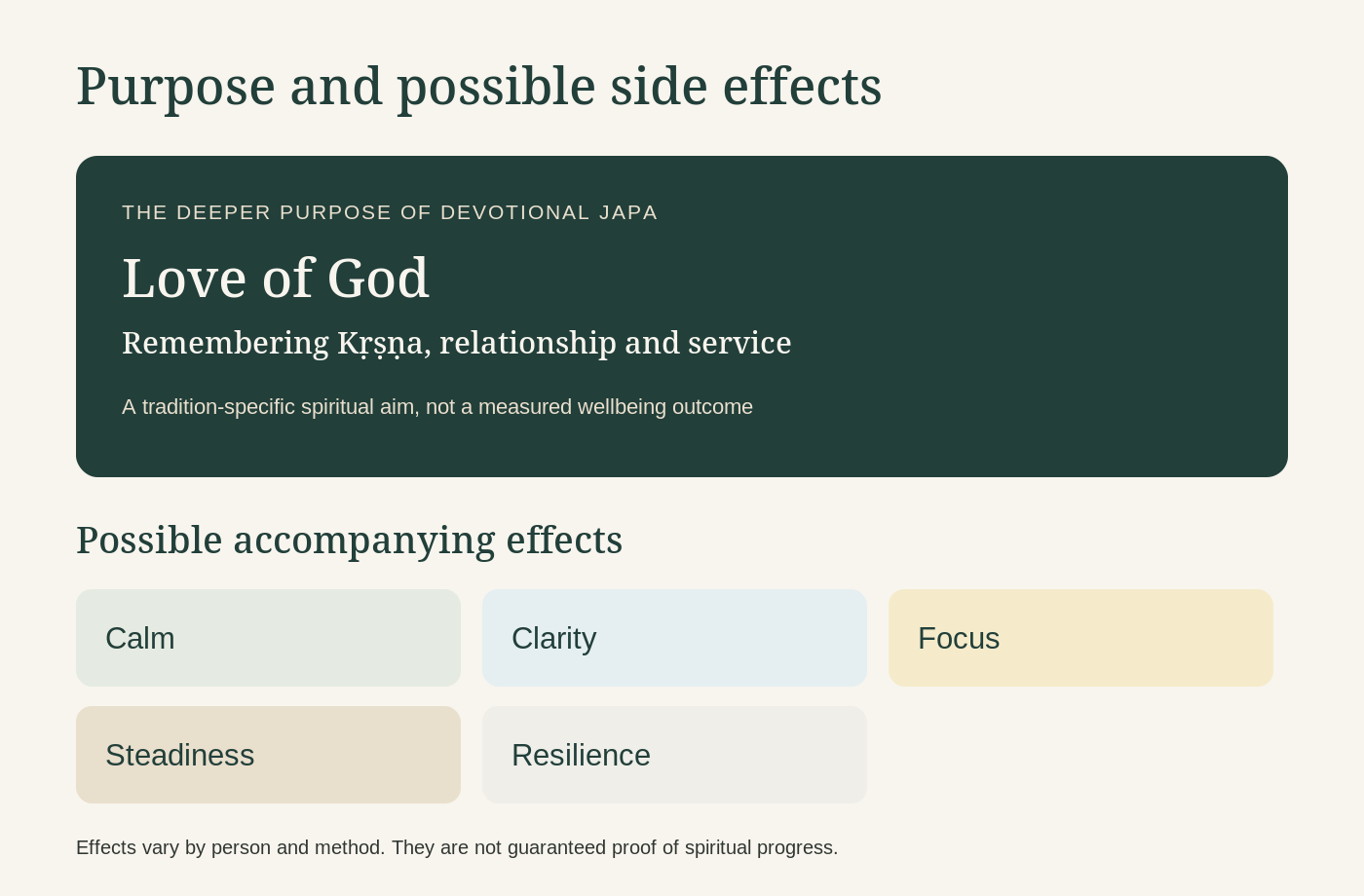
The goal of meditation and its possible side effects
A calmer mind or a change in attention can be valuable. Neither, by itself, establishes spiritual realization. In the devotional understanding presented here, the goal concerns our relationship with Kṛṣṇa; calm, concentration and other possible effects should not be treated as identical to that goal or as guaranteed results.
Practice also has consequences for how we live. The question is not only what happens during a session, but whether our understanding and conduct are developing over time.
Continue exploring
This guide gives an introduction and enough practical direction to begin. Questions about spiritual truth, unusual experiences and the development of character need their own fuller discussion.


Practice source
The practical description of the mālā and hand position follows Krishna.com’s chanting guide. The traditional narrative and theological explanations above are presented in their own terms, separately from the EEG and clinical studies.


Leave a Reply