Why Is Meditation So Difficult?
The essence
- Different difficulties call for different adjustments, from posture and timing to how you return your attention.
- The guide considers distraction, discomfort, routine, doubt and the challenges that can arise in Japa.
A practical guide to distraction, physical discomfort, doubt, routine, and the things that happen when we try to bring our attention somewhere on purpose.
Most of us can sit down for a few minutes. The hard part begins when we try to decide where the mind should go. A small pain suddenly commands all our attention. A conversation from yesterday resumes inside our head. Or we repeat a mantra while planning what to do after breakfast. On other days, the practice feels steady but apparently fruitless. We begin to wonder whether it is doing anything at all.
These are not merely inconvenient interruptions to meditation. They raise useful questions about attention, habit, expectations, and, in devotional meditation, what it means to turn toward someone beyond ourselves.
There is no single solution to every difficulty. Some call for a change in posture or schedule. Others demand a more honest look at the purpose of the practice. Below, each problem is treated as a real part of meditation, not as a fault to be concealed.
Where this guide fits: For the foundations of meditation, including silent awareness and Hare Kṛṣṇa mantra meditation, see Meditation. This article deals with the difficulties that arise in practice.
Meditation: the foundation guide
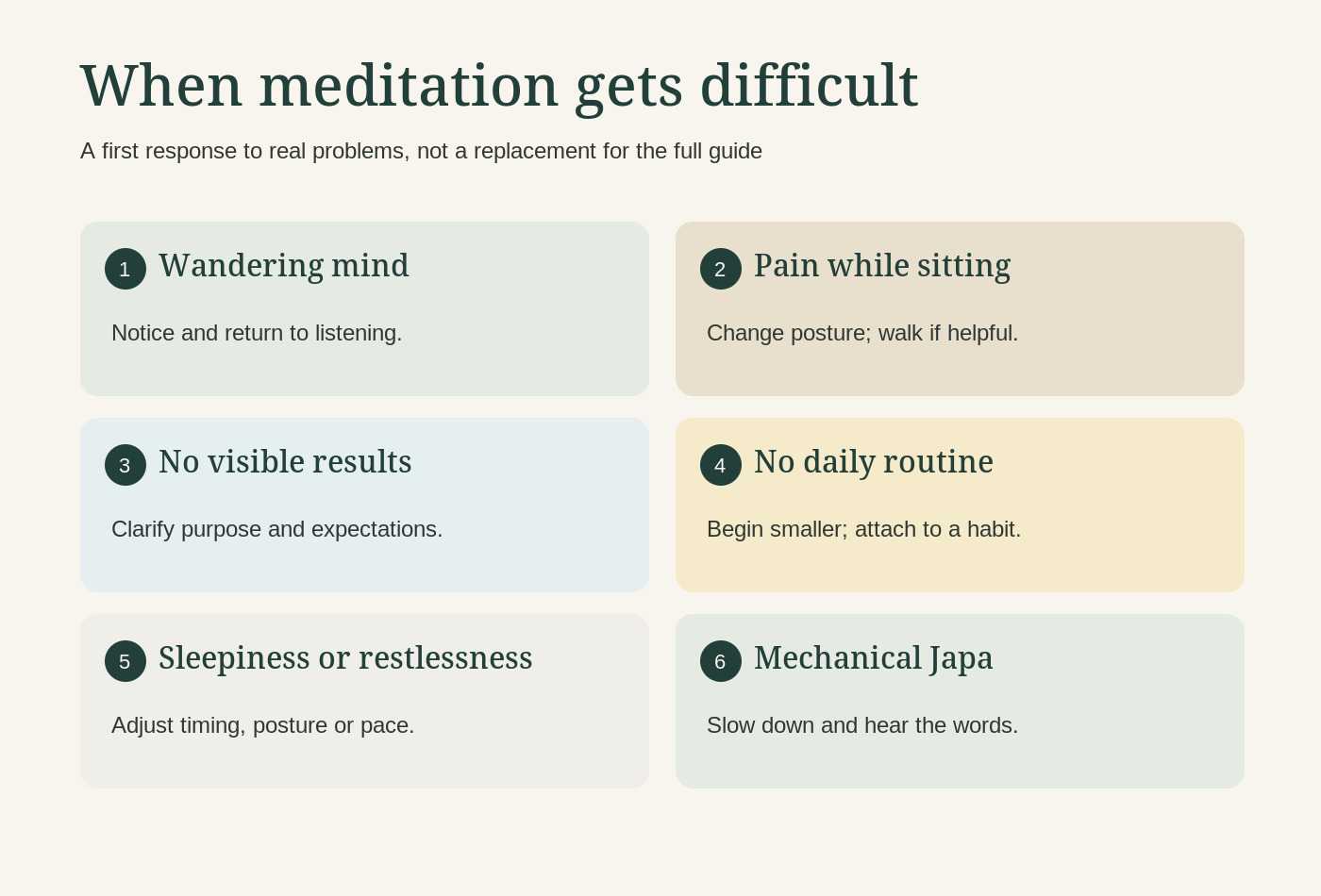
1. My mind keeps wandering
You begin with an intention. Perhaps you want to follow the breath, hear a sacred name, or attend carefully to one prayer. Ten seconds later, you are thinking about work, a conflict, food, money, or a memory you did not deliberately invite. You notice that you are distracted and feel you have already failed.
The first distinction matters: noticing a wandering mind is not the same as failing to meditate. Meditation involves deliberately directing attention and, repeatedly, finding that attention has moved elsewhere. A beginner may experience more distraction precisely because the practice makes it visible. The thoughts need not be new; what is new is the attempt to watch their movement.
Our attention is also shaped by the things we repeatedly follow. Habitual inputs, emotionally charged concerns, and unfinished intentions can continue to attract the mind after we sit down. We should not expect a few minutes of meditation to erase the momentum of an entire day.
What helps: Choose one clear object for the session. In silent awareness, this might be the breath or a deliberately open observation of your present state. In Japa, it is the sound of the Hare Kṛṣṇa mantra. When the mind wanders, recognize what happened without beginning an argument with yourself. Hear the next mantra clearly. Then the next. Do not try to settle every intrusive thought before continuing.
If distraction is constant, change one practical condition: put the phone away, begin with a shorter period, or chant audibly enough for your own ears to follow. A less distracting environment is helpful, but it is not necessary to eliminate every sound or thought before you start.
Try this: During one session, notice three times when your attention leaves the object. Each time, return deliberately. Afterwards ask: Where was my mind drawn, and what might that reveal about what matters to me right now?
2. Sitting hurts, and I cannot stay comfortable
Back discomfort, pressure in the knees, tingling feet, stiff hips, or tension in the neck can occupy every moment of a session. Some people then assume that discomfort proves a lack of discipline, or that spiritual seriousness requires them to remain motionless.
Neither assumption is a good starting point. Posture should support attention, not become a competition in endurance. Different bodies have different needs. Traditional sitting postures may be useful for some practitioners, but they are not the only legitimate way to engage in attentive practice.
What helps: Choose a stable position you can reasonably maintain. Use a supportive chair, adjust the height of a cushion, or rest your feet on the floor. Keep your posture natural instead of forcing the spine rigidly straight. Shorten the session when necessary. Stand up and continue if sitting ceases to be helpful.
For Japa, walking while chanting can be an entirely practical option. It is still important to listen to the mantra rather than turning the walk into an occasion for constant distraction. Walking may support alertness and relieve the difficulty of sitting, but it is not automatically more concentrated.
Do not push through sharp, worsening, persistent or unusual pain for the sake of a meditation target. Seek appropriate medical advice if pain is concerning or recurring. Meditation instructions are not a substitute for assessing a physical problem.
Try this: Compare five minutes of comfortable sitting with five minutes of gentle walking Japa. Which posture makes careful listening more possible? Keep that observation, not a borrowed image of what a meditator ought to look like.
3. I do not see any results. Does meditation actually work?
This concern is especially important because it can sound like a theoretical doubt while arising from a very ordinary experience: I have spent time doing this, and nothing seems different. We should not dismiss it with a slogan about patience. Sometimes expectations are unclear. Sometimes the chosen method is not being practiced consistently. Sometimes a person needs better guidance. And sometimes the promised effects are more modest or uncertain than they were led to believe.
Begin by separating three questions: What result was I expecting? What kind of practice am I doing? How would I recognize meaningful change? A person who begins a relaxation practice may reasonably look for changes in tension, mood, or day-to-day stress. Someone practicing Japa in a Gauḍīya Vaiṣṇava setting is approaching sacred sound as devotional practice; its spiritual purpose cannot simply be reduced to whether a session produces a pleasant emotion.
Calm, clarity, attention, and resilience can be valuable possible effects, but they should not be promised on demand. A difficult session does not prove failure, and a blissful one does not prove spiritual realization. Nor can a scientific study of a particular meditation program establish every claim made for every tradition.
What helps: Examine the conditions honestly. Have you practiced regularly enough to learn the method? Do you spend the session actually listening to the mantra, or merely finishing repetitions? Is the environment consistently disruptive? Are you expecting a dramatic state instead of noticing subtler changes in behavior, patience, responsibility, or attentiveness? Could the practice be unsuitable for your present needs, or would a competent teacher help clarify it?
You can make a simple, modest record without turning meditation into an achievement contest. Note how often you practiced, whether you were attentive, and what difficulties recurred. Over time, examine whether the practice changes how you respond to thoughts, impulses, and other people. These observations are not a measure of spiritual attainment. They may, however, help you learn what is and is not happening.
In devotional practice, the question of results opens into another: Am I approaching the Holy Name primarily to get a state, or am I learning to hear and address the Divine? This is a question about the purpose of Japa, not a demand that a beginner should already feel deep devotion.
Try this: Write down one expected result and one reason for practicing that does not depend on feeling better immediately. Return to these two statements after a couple of weeks. Do they still describe what you are actually doing?
The Meditation pillar distinguishes the goal of meditation from its possible positive side effects.
4. I cannot establish a regular routine
Many people have no difficulty agreeing that meditation matters. The difficulty is remembering, beginning, and making space for it when other responsibilities feel more urgent. An ambitious first week can be followed by a long silence. A missed day can then become a reason to stop completely.
A practice is not made sustainable by enthusiasm alone. It needs a place in ordinary life. Routines work better when the starting point is realistic, the next step is clear, and returning after interruption is treated as normal rather than embarrassing.
What helps: Set a minimum daily commitment you can genuinely keep. Choose an existing anchor, such as after washing in the morning or before beginning work. Prepare the place and mālā in advance. Reduce the number of decisions required to start. If a longer session is possible, welcome it; if not, complete the modest commitment rather than abandoning the practice.
Consistency should not become a rigid form of self-punishment. Illness, family duties, sleep needs, and other legitimate constraints change what is realistic. A routine is meant to support the underlying purpose, not to replace it.
Try this: Choose one time, one location, and one minimum duration for seven days. Record whether you began, not whether every session was impressive. After the week, adjust the plan based on what actually happened.
5. I become sleepy, restless, or mentally agitated
Meditation removes many of the distractions that ordinarily help us ignore fatigue or agitation. Sometimes we sit down and discover that we are already exhausted. At other times, silence seems to intensify our urge to move, check something, or escape.
There is no single cause. Sleep debt, timing, prolonged sitting, stimulants, emotional stress, and simple unfamiliarity with the practice can all matter. It would be a mistake to label every tired session as spiritual weakness or every restless session as evidence that meditation is unsuitable.
What helps with sleepiness: Consider a time of day when you are naturally more alert. Sit upright, open your eyes if appropriate, stand, or chant audibly. Make sure the underlying need for sufficient sleep is not being ignored.
What helps with restlessness: Simplify the environment, begin with a short attainable session, and do not add the demand to feel peaceful. Walking Japa or appropriately participatory kīrtan can sometimes support engagement when sitting quietly is difficult. Each has its own form and purpose; they should not be treated as interchangeable ways to manufacture calm.
Try this: For three sessions, observe whether the difficulty is primarily physical tiredness, nervous energy, or recurring concerns. Try one appropriate practical change rather than changing the entire method each day.
6. Japa feels mechanical
It is possible to complete many repetitions while barely hearing the words. The fingers move and the lips chant, yet the mind spends much of the time elsewhere. Sometimes speed replaces attention. Sometimes the repetition becomes so familiar that we no longer ask what we are addressing or why.
Mechanical practice is a real danger, but it is also a recognizable problem that can be approached intelligently. It does not require pretending to have profound feelings. In Gauḍīya Vaiṣṇava devotional practice, technique and attentive hearing matter, while the inner orientation of prayer and service gives them a deeper purpose.
What helps: Slow down enough to hear each part of the mantra distinctly. Attend to pronunciation without converting the session into anxious self-monitoring. Begin a round with a brief recollection of why you are chanting. When you notice that you have stopped listening, simply return. If uncertainty persists, seek guidance from a trustworthy, qualified practitioner rather than collecting endless competing tricks.
Try this: For a short portion of your practice, make one task central: hear the words your own voice is producing. Afterwards ask whether slowing down helped listening, not whether you produced a special experience.
7. Difficult emotions or memories appear
Sometimes quiet practice makes difficult emotions easier to notice. Sadness, anger, fear, grief, shame, or an old memory may come forward when ordinary activity slows down. This can be unsettling, especially when someone assumed meditation would immediately make them peaceful.
Not every emotion needs to be suppressed. But neither should we claim that every distressing experience is a necessary stage of purification. A meaningful spiritual framework does not cancel the need for ordinary care, appropriate boundaries, and, when useful, professional support.
What helps: Do not force yourself to continue a practice that is causing significant distress. Open your eyes, orient to the room, stand up, or stop. If necessary, choose a shorter and more grounded practice, or seek an experienced and responsible guide. If difficult memories, panic, dissociation, or persistent distress arise, consider support from a qualified mental-health professional. Meditation is not a replacement for treatment.
Try this: After a manageable session, name what arose without judging yourself for having experienced it. Ask whether the response needed is a practical adjustment, a conversation, rest, or further support.
8. I lose motivation and start to doubt myself
Even when a person knows how to meditate, the attraction may fluctuate. Some days the practice feels meaningful. On other days it competes poorly with entertainment, social obligations, or the mind’s preference for immediate stimulation. If the routine breaks, self-criticism may become louder than the original intention.
A useful distinction is between motivation and direction. Motivation rises and falls. Direction is the considered reason we return. It helps to remember what made the practice worth beginning, whether that was a search for greater attentiveness, an interest in self-understanding, or a devotional wish to remember Kṛṣṇa.
What helps: Lower the barrier to re-entry. Return with one manageable session rather than trying to compensate for every missed day. Talk with a reliable practitioner if you need clarification or encouragement. Revisit your purpose honestly; if the method or expectation is wrong for you, reflect on that rather than confusing perseverance with stubbornness.
Try this: Finish the sentence, “I want to return to this practice because…” Keep the answer concrete. It need not sound impressive.
What all these difficulties have in common
Distraction, pain, doubts, inconsistency, and dry or mechanical repetition are different problems. They do not call for one magic solution. Yet each asks us to notice what is actually happening rather than maintaining an idealized picture of meditation.
The larger WWFO question remains relevant: What repeatedly receives our attention, and what begins to shape us as a result? Meditation can become a deliberate way to investigate that question and, in devotional practice, to turn attention toward a relationship considered worthy of it.
A next step need not be dramatic. Choose one difficulty that describes your current practice. Make one honest change. Then return to the practice itself.