A CONVERSATION ABOUT LIFE, CHOICE AND DEVOTION
What should I do when I no longer know what is right? The Bhagavad-gītā begins with that human difficulty.
Arjuna, a warrior, faces a battle involving people he loves and respects. Overwhelmed, he turns to Kṛṣṇa, his friend and charioteer, for guidance. Their conversation becomes an inquiry into the self, our responsibilities and our relationship with God.
The Gītā is a Sanskrit dialogue within the Mahābhārata. Its setting matters: Arjuna’s hesitation concerns the harm that action can do and the responsibilities he believes he cannot escape.
The dialogue connects action, knowledge and devotion. Its claims about the self and liberation belong to its philosophical and spiritual argument.
What is the Gītā asking us to understand?
Who am I?
Kṛṣṇa teaches that the self continues while the body changes. Prabhupāda explains this self as the soul: a conscious person with an enduring relationship with Kṛṣṇa.
How should I act?
Daily responsibilities can become part of spiritual life. Prabhupāda explains that work offered for God’s satisfaction has a different purpose from work done only for our own reward.
Where should my love go?
The conversation leads toward a personal relationship with Kṛṣṇa. Remembering Him, becoming His devotee and offering service are central to Prabhupāda’s explanation of bhakti.
Read with context
The Gita is part of the Mahabharata and speaks within a particular narrative, philosophical and devotional world. No short guide can stand in for the text or for the communities that have carried it.
Commentators can agree that the verse calls for devotion and still differ on how it relates to liberating knowledge. In their readings of 6.47, Śaṅkara describes the highest yogin as inwardly absorbed in and devoted to Kṛṣṇa. Rāmānuja stresses loving devotion to the Supreme Person. Prabhupāda’s Gauḍīya Vaiṣṇava commentary likewise treats loving service to Kṛṣṇa as central. These are readings of the text from distinct traditions.
A four-part reading path
Use this as a simple route through your own reading. You can read slowly, return to a question and take time with the commentary.
- The scene and the crisis: why action becomes a question.
- Duty and consequence: acting without pretending outcomes are fully ours to control.
- Knowledge, practice and devotion: different paths discussed in the text.
- The final choice: responsibility, interpretation and what a reader carries forward.
Reading notes and sources
Compare Śaṅkara and Rāmānuja on 6.47 at IIT Kanpur’s Gita Supersite. Bhagavad-gītā As It Is is the translation and commentary by A. C. Bhaktivedanta Swami Prabhupāda. The verse links above use that edition.
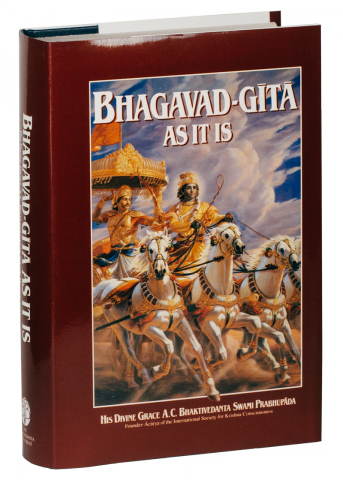
Translation and commentary by Śrīla Prabhupāda. Sanskrit verses, English translation and explanations.
Book cover: © The Bhaktivedanta Book Trust, from the publisher’s Standard Edition catalogue.