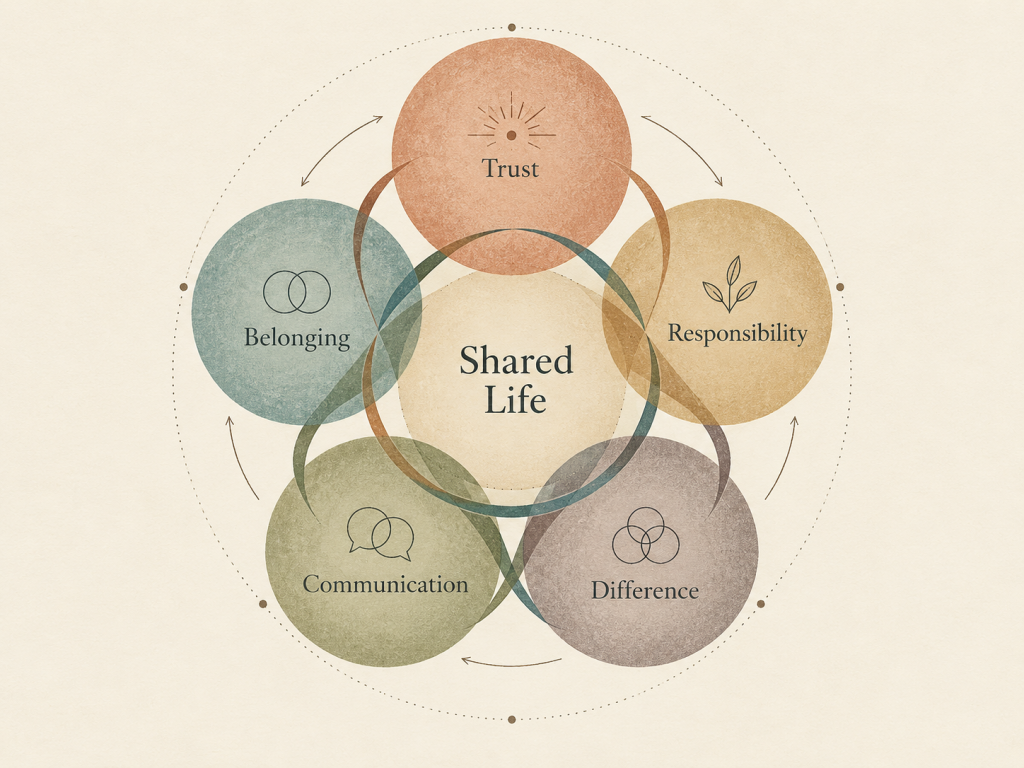
In an apartment building, people who barely know each other may share a staircase, a water supply, and the responsibility to keep an entrance safe. They may have different languages, beliefs, habits, incomes, and ideas about what a good life looks like. None of those differences prevents them from living alongside one another.
But neither does living close together automatically make them a community.
A neighbor may keep an eye on someone’s home while they are away. Another may help an elderly resident carry groceries. Someone may report a broken light before anybody is hurt. Small actions like these are rarely described as the foundations of society. Yet much of our common life depends on people being willing to do things that do not benefit only themselves.
What allows people to cooperate, especially when they do not agree about everything?
Living together is not the same as thinking alike
We sometimes imagine a united community as a place where people share the same values, traditions, and opinions. Shared convictions can indeed make cooperation easier. A familiar way of life can provide language, expectations, and a sense of belonging.
But complete agreement is neither possible nor always desirable. Even within a family, people may differ about money, work, religion, or how children should be raised. In a city, differences are multiplied. We depend on people whose lives we may barely understand.
If belonging requires everyone to resemble us, the circle becomes very small.
A more demanding kind of togetherness allows disagreement without making every difference a threat. People need not pretend that their convictions are identical. They need enough common ground to treat one another as participants in a shared life.
That common ground can be modest: an agreement not to harm one another, a willingness to keep promises, respect for fair procedures, or an understanding that certain needs deserve consideration even when they belong to someone unlike ourselves.
The quiet importance of reliability
Trust is sometimes described as a warm feeling about other people. But daily cooperation often rests on something more practical: the expectation that others will do what they have good reason to do.
A bus driver follows a route. A nurse explains a treatment accurately. A shopkeeper gives the right change. A public office applies the same rules to people it likes and dislikes. Much of this happens between strangers.
We cannot personally verify every part of the systems on which we depend. We rely on competence, honesty, standards, and the possibility of correction when something goes wrong.
That does not mean people should trust blindly. Unquestioning confidence can make a community vulnerable to exploitation. Trust becomes more reasonable when responsibilities are clear, errors can be acknowledged, and those with authority remain answerable for their decisions.
There is also a difference between trusting a particular person and feeling able to trust the arrangements that govern life together. We may respect a neighbor while doubting the fairness of an institution. We may believe a rule is sensible but know that it is applied unevenly. These distinctions matter when we ask why some communities feel secure and others do not.
We sometimes imagine a united community as a place where people share the same values, traditions, and opinions.
Shared life is built through ordinary exchanges
A neighborhood is not held together only by grand acts of solidarity. It also depends on small opportunities to recognize one another as people.
We exchange greetings. We learn who needs quiet at certain hours. We discover that the person whose customs once seemed strange has worries and responsibilities much like our own. We might disagree strongly about politics and still help each other during a storm.
These encounters do not automatically remove prejudice or produce friendship. A forced interaction can deepen resentment if it is unfair or humiliating. And people have different amounts of time and security to give. A person working long hours may contribute less visible community activity while still doing their share in other ways.
Nevertheless, a shared life becomes more imaginable when others are not only distant categories. Cooperative work gives people opportunities to see one another’s reliability, limits, and needs.
The question is not how to make everyone close friends. It is how to make everyday coexistence less dependent on suspicion.
Fairness matters more than friendly language
Calls for unity can sound generous while hiding real problems. If one group is asked to be patient while another is allowed to make all the decisions, appeals to togetherness may protect the imbalance rather than resolve it.
Fair procedures matter precisely because people do not always agree. They offer ways to settle disputes, distribute responsibilities, and challenge decisions without depending entirely on personal favor.
That is not a guarantee that any institution calling itself fair will act fairly. Rules can be poorly designed or selectively enforced. People may have unequal access to the processes meant to protect them. A community that takes cohesion seriously must be willing to examine those failures.
A sense of belonging is stronger when it is not conditional on surrendering legitimate concerns. People need room to say that something is wrong without immediately being treated as enemies of the group.
The United Nations Economic Commission for Europe treats social cohesion as a broad, multidimensional subject involving trust, belonging, social connections, participation, institutions, and inequality. That is a useful warning against reducing it to a single feeling of closeness.
What disagreement can reveal
It is easy to speak warmly about differences when they do not affect anything important. The harder test comes when people want incompatible things.
Residents disagree about noise. Parents disagree about what a school should teach. Citizens disagree about how public money should be spent. Sometimes interests genuinely conflict, and no amount of mutual understanding will make every preference possible.
A durable community needs a way to remain a community while addressing those conflicts. That can mean hearing a complaint without assuming disloyalty, protecting a minority from an unjust majority, or accepting that an agreed process may produce an outcome we dislike.
A conflict is not necessarily a sign that common life has failed. It may reveal an issue that was previously ignored. The question is whether disagreement can be handled without denying the standing of the people involved.
Nor should we romanticize compromise. Some demands are unjust and should be refused. Togetherness cannot require people to accept mistreatment in order to preserve an appearance of peace.
The danger of belonging at any cost
Strong communities can also become closed communities. Shared loyalties may encourage generosity within the group and indifference toward those outside it. People may become reluctant to question their own side, especially when disagreement threatens friendships or identity.
There is a difference between caring about a community and assuming that whatever protects its image must be right.
A community worth holding together should be able to correct itself. It should make space for newcomers without requiring that every difference disappear. It should not ask people to choose between honesty and belonging whenever something goes wrong.
Belonging can be a strength, but the quality of what holds a group together matters as much as the strength of the bond.
The kind of community we help create
Most of us cannot redesign the institutions around us. We can, however, take part in some of the relationships and practices through which common life is maintained.
We can keep a promise when it would be convenient not to. We can acknowledge another person’s contribution. We can ask whether a rule we support is fair to those who have less power to refuse it. We can make disagreement more honest by trying to understand what is actually being disputed.
None of these actions substitutes for good institutions. Nor can personal courtesy repair every social division. The responsibility to maintain a shared life belongs, in different ways, to individuals, communities, and those who govern them.
What holds us together is not merely the fact that we occupy the same space or repeat the same words about unity. It is the reliability, mutual recognition, and fair arrangements that allow different people to carry on a life together, even when they would not have chosen the same life for themselves.
For a related question, consider what makes trust reasonable between people.
Sources and context
- UNECE (2023), *Social Cohesion Concept and Measurement*. A conceptual and measurement review; its multiple dimensions should not be read as proof that particular neighborhood activities cause cohesion.


Leave a Reply